Trailheads
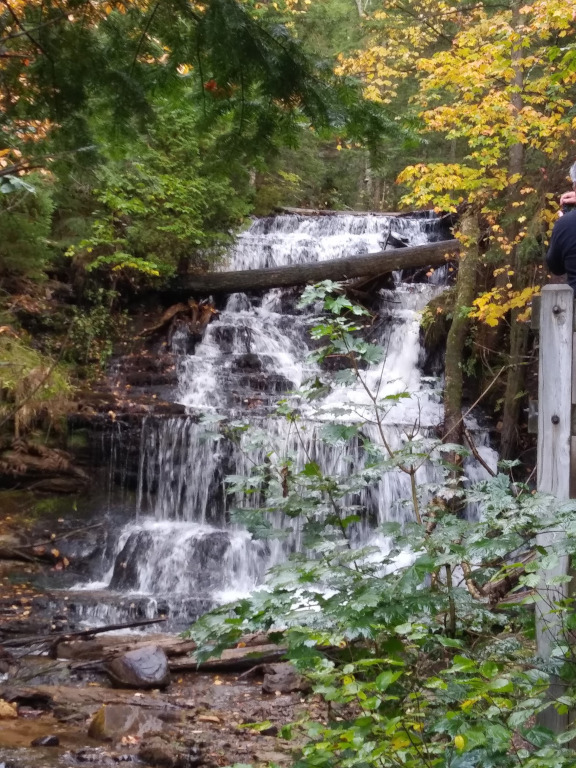
While hiking the Fox River Pathway, we discovered that there was a campground nearby called the Fox River Forest Campground. Along the hike along the river, we discovered what looked like a waterfall, but it was not designated as such. It was a great site regardless.
Here are some trail signs along the hike and an image of a fire pit at the nearby campsite.


Along the way, we discovered this small waterfall and interesting tree formations. The trail itself is not maintained well, so parts of it are difficult to hike. To me, it just added more rustic beauty along the hike, and there was plenty of that!
I managed to get a close-up picture of a dragonfly along the way. Here is a quick funny story about dragonflies. My wife discovered a dragonfly larva in a pond, not knowing what it was she added it to a bucket of water along with some tadpoles. The dragonfly larva got very excited and proceeded to eat the tadpoles. I couldn’t believe how much that thing could eat! This freaked out my wife, and she quickly removed the dragonfly larva before it could eat the rest of the tadpoles she was going to show her students.


Be care of eating any mushrooms you find along the way. They could be safe to eat, deadly, or be a poisonous version of what looks like a mushroom that is safe to eat. Don’t ever take the chance unless you know what you are doing.
The first two pictures of mushrooms appear to be Fly Agaric (Amanita muscaria).
A few features in your photo point strongly in that direction:
- 🟠 Bright orange/yellow cap
- ⚪ White patches/warts scattered across the cap
- 🌲 Growing among pine needles, which is a typical habitat
- 🦶 Pale, stout stem with what appears to be remnants of the bulb/volva at the base
- The overall shape is very characteristic of an Amanita
⚠️ Don’t eat this one
Fly agaric contains ibotenic acid and muscimol and can cause significant neurological effects, including vomiting, confusion, hallucinations, loss of coordination, and in serious cases, seizures or coma. The amount of toxins can vary considerably between mushrooms.
The third mushroom is a Lion’s Mane Mushroom, which is also called Bearded Tooth or Pom-Pom Mushroom.
- Single, solid, rounded mass rather than branching
- Lots of long, dangling white teeth/spines
- Creamy white/yellow coloration
- No traditional cap or gills
- Growing from wood, which is where Hericium erinaceus is normally found
One thing I’d check
The biggest question is whether the mushroom is truly unbranched. H. erinaceus forms one mass with the teeth hanging from it. Some of its relatives, particularly Bear’s Head Tooth (Hericium americanum), have a more obviously branched structure.
Is it edible?
Lion’s Mane is considered an edible mushroom, but I wouldn’t recommend eating a wild specimen based solely on finding it in the wild unless you know what to look for. With wild mushrooms, identification should be confirmed from multiple characteristics—including the tree it was growing on, attachment point, underside/teeth, and the entire fruiting body—before consuming it.


You can learn more about this trail by reading this trail post on the Fox River Pathway.
Leave a Reply